Mid-ocean ridge seismicity
My research investigates the fundamental processes controlling earthquake generation and crustal evolution in submarine environments. I use global seismic and dense hydroacoustic networks to detect and analyze microearthquake swarms, quantifying the roles of magma intrusion, faulting, and fluid interactions at mid-ocean ridges. By applying advanced signal processing and catalog development techniques, I generate high-resolution records of seismicity that shed light on volcanic and tectonic dynamics beneath the ocean floor.

A network of underwater hydrophones deployed in the Indian Ocean to monitor low-magnitude seismic activity along the three mid-ocean ridges

Hydroacoustic recording of submarine landslide originated in the Trou Sans Fond Canyon near Ivory Coast in March 2024
Submarine landslide hazards
I study submarine landslides—powerful underwater slope failures that can damage critical infrastructure such as communication cables and pose tsunami hazards. My work uses hydroacoustic and seismic monitoring data to detect, locate, and analyze these events in near real time. By linking observed signals to seafloor morphology and geological processes, I aim to improve our understanding of submarine landslide triggers and contribute to hazard assessment and risk mitigation for vulnerable offshore regions.
Seismicity in Subduction Zones
I investigate submarine volcanic and seismic activity in remote settings, where traditional seismic monitoring is limited. By leveraging seismic and hydroacoustic records, I detect, catalog, and characterize earthquakes, using azimuth analysis within tight network geometries to improve event localization and source characterization. This work improves our ability to monitor volcanic hazards in data-sparse regions and contributes to study subduction zone processes.

Alaska subduction zone, hosting several volcanic islands and monitored by a hydrophone network
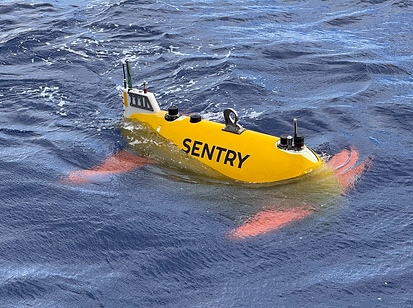
Autonomous underwater vehicle "Sentry" descending down to collect high-resolution bathymetric & magnetic data
Seafloor Magnetic Mapping
My research focuses on investigating the structure and evolution of the oceanic crust along mid-ocean ridges using magnetic data collected by autonomous underwater vehicles (AUVs). By analyzing high-resolution magnetic anomalies, I track variations in crustal magnetization that record the history of seafloor spreading, lava emplacement, and tectonic deformation. These datasets provide detailed insights into the processes that shape new oceanic crust and improve our understanding of magmatic accretion, ridge segmentation, and the interactions between tectonics and volcanic activity beneath the ocean surface.
Machine learning for hydroacoustic detection of earthquakes
My research applies machine learning techniques to advance the hydroacoustic detection of earthquakes. I aim to improve event localization through automated identification of signal arrivals and pattern recognition in complex time–frequency domains. These methods help reduce errors in origin estimates, extend earthquake catalogs into oceanic regions where land-based seismic coverage is sparse, and offer a more detailed view of tectonic and magmatic processes beneath the seafloor.

Hydroacoustic path geometry from source location to hydrophone

Tidal triggering of microseismicity along the Quebrada-Discovery-Gofar transform fault system of the East Pacific Rise
Tidal triggering of transform faults seismicity
My research also examines the structure of the oceanic lower crust and the Moho transition zone. Using synthetic seismogram modeling, I investigate how variations in crustal and mantle properties influence the character of seismic arrivals and reflections. These modeling experiments allow me to design survey geometries that are best suited for imaging the Moho in challenging deep-sea environments. This work improves the efficiency and resolution of geophysical investigations and provides new constraints on the processes of crustal accretion, lithospheric evolution, and the formation of the oceanic crust-mantle boundary.
Seismogram modeling of oceanic crust and Moho
My research investigates the role of tidal stresses in modulating microseismic activity along oceanic transform faults (e.g. Quebrada, Discovery, Gofar transform fault system along East Pacific Rise). By analyzing high-resolution earthquake catalogs and tidal strain models, I examine whether fault systems at mid-ocean ridges exhibit sensitivity to periodic tidal loading. Identifying tidal triggering patterns provides insight into the stress state and strength of these faults, offering clues about how close they are to failure and how external forces may influence earthquake nucleation.

Synthetic seismograms for different models in the lower crust, including constant velocity, positive, and negative gradients
velocity in the lower crust